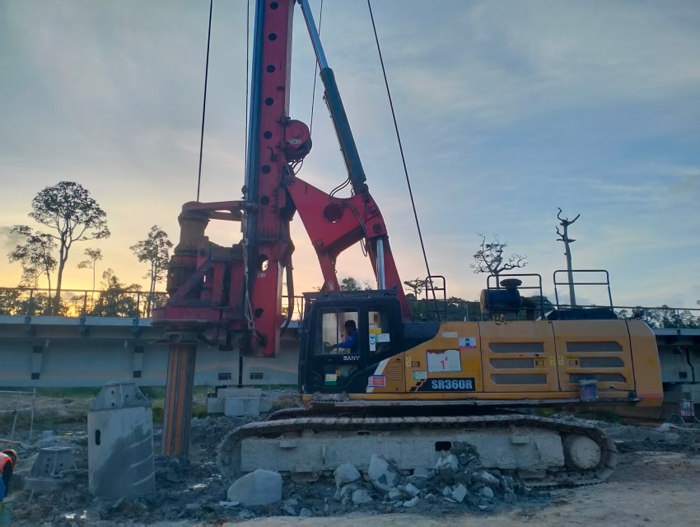
The East Coast Rail Link (ECRL) in Malaysia is a national-level key infrastructure project. With a total length of 665 kilometers, the line is designed for a maximum passenger speed of 160 km/h and a freight speed of 80 km/h. Constructed by China Communications Construction Group, it connects five states in Malaysia and features a total of 20 stations. Our company was awarded the contract for the construction of bored cast-in-place piles for the ROB bridge on the main line during Phase 2 of Section 5, as well as for railway and highway bridges within the branch line areas. The construction area covers the Kuching Branch Line and the Kamarun Branch Line in Terengganu State, and the Kuantan Branch Line in Pahang State.
Construction began in April 2023 and was completed in April 2026. In total, pile foundation work was completed for 14 bridges of various sizes, with a cumulative total of 1,914 bored cast-in-place piles with diameters of 1.0 m, 1.2 m, and 1.5 m. Throughout the entire construction process, we strictly adhered to the general contractor’s unified management, scientifically scheduled construction sequences, dynamically coordinated on-site resources, and completed all construction milestones on time and to quality standards.
The project spanned a wide area, with significant variations in geological conditions across the various branch lines and bridge pile sites, resulting in a substantial volume of rock drilling work. Specifically, the Ju-Cha Branch Line consisted primarily of granite and basalt strata; the Kamawan Branch Line featured predominantly granite strata; and the Kuantan Branch Line was dominated by limestone strata. To address the complex hard rock geology, the project deployed SR360 rotary drilling rigs. By optimizing drill bit design, monitoring roller bit wear, and analyzing drilling efficiency, the team effectively increased drilling speed and construction efficiency in hard rock formations.
Uneven sand layer thickness and excessive cuttings accumulation at the bottom of the borehole were the primary construction challenges for this project. The project team implemented dual control measures: adjusting drilling fluid parameters based on variations in sand layer thickness to stabilize the borehole walls and suppress sediment accumulation; and employing an air-lift reverse circulation process to thoroughly displace sediment at the bottom of the borehole, effectively resolving quality issues related to borehole formation in sand layers.
The project strictly enforced the quality control system by establishing a dedicated quality team and rigorously monitoring construction quality through measures such as drawing briefings, geological briefings, and on-site supervision of critical processes. For pile foundations longer than 40 meters, ultrasonic testing was used; for those shorter than 40 meters, small-strain testing was employed. All pile foundations passed inspection and were classified as Class I piles.
Throughout construction, the project adhered to the principle of “safety first, prevention foremost,” achieving the goal of zero safety incidents. The project also demonstrated outstanding results in civilized construction and environmental protection, earning unanimous recognition from both the client and the supervising agency.