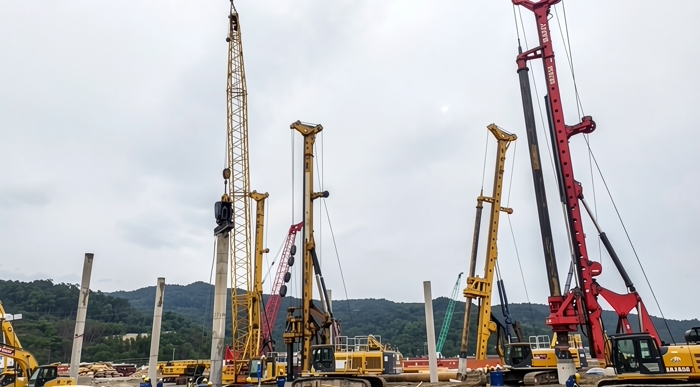
This project is located in Hamahera Regency, North Maluku Province, Indonesia. The project owner is KAI, and CHCI is responsible for the construction work, primarily overseeing the construction of cast-in-place pile foundations for the electrolysis workshop and supporting public and auxiliary workshops. The project involved the construction of a total of 2,309 Φ800mm cast-in-place piles, with a total concrete pour volume of 35,524 m³ and approximately 1,908.35 metric tons of reinforcing cages fabricated and installed.
Construction officially commenced on March 1, 2025, and was completed on August 19, 2025, with a total construction period of 172 calendar days. The project site contained thick layers of mixed fill consisting of smelting tailings. The nickel smelting tailings formed a deep, recently backfilled layer of non-cohesive, loose soil, resulting in complex construction conditions and high technical difficulty. Using the traditional method of directly lowering the casing with a vibratory hammer, the maximum penetration depth could only reach 9 m. Due to significant lateral friction resistance from the soil layers, the installation of extra-long casings proved difficult to implement, becoming a key bottleneck hindering project progress.
To address these construction challenges, the project team actively pursued technical solutions and innovatively applied a construction method involving “alternating operations of a large-diameter guide casing and a small-diameter working casing.” During construction, the large casing was first installed using vibration, and the tailings inside were excavated to eliminate lateral friction resistance from the overlying strata; subsequently, an extra-long small-diameter casing was lowered into the interior of the large casing. After installation, the large casing was retrieved, leaving the small casing to independently serve as the retaining wall. This method increased the depth to which the casing could be driven using a vibratory hammer from the original 9 meters to a maximum of 30 meters, successfully resolving the industry-wide challenge of installing extra-long casings in deep, loose tailings strata. Based on this innovation, the project has cumulatively obtained two utility model patents and one Hebei Provincial Construction Method certification.
Upon project completion, all pile foundation quality inspections were passed, with 100% of the piles classified as Class I and II; strict safety controls were maintained throughout the project, achieving the safety goals of zero injuries and zero accidents; ecological and environmental protection requirements were strictly enforced, with excavated soil and construction waste disposed of in compliance with local environmental regulations; and the project successfully passed the comprehensive acceptance inspection.
This project has established a comprehensive technical system for pile foundation construction in large-scale industrial plants located in areas with thick layers of smelting tailings. It efficiently and successfully completed the pile foundation construction for the electrolytic aluminum plant, laying a solid foundation for the construction of the main structure of the upper electrolytic workshop. At the same time, it provides practical experience that can be referenced for pile foundation construction projects in similar industrial sites overseas with tailings strata.